
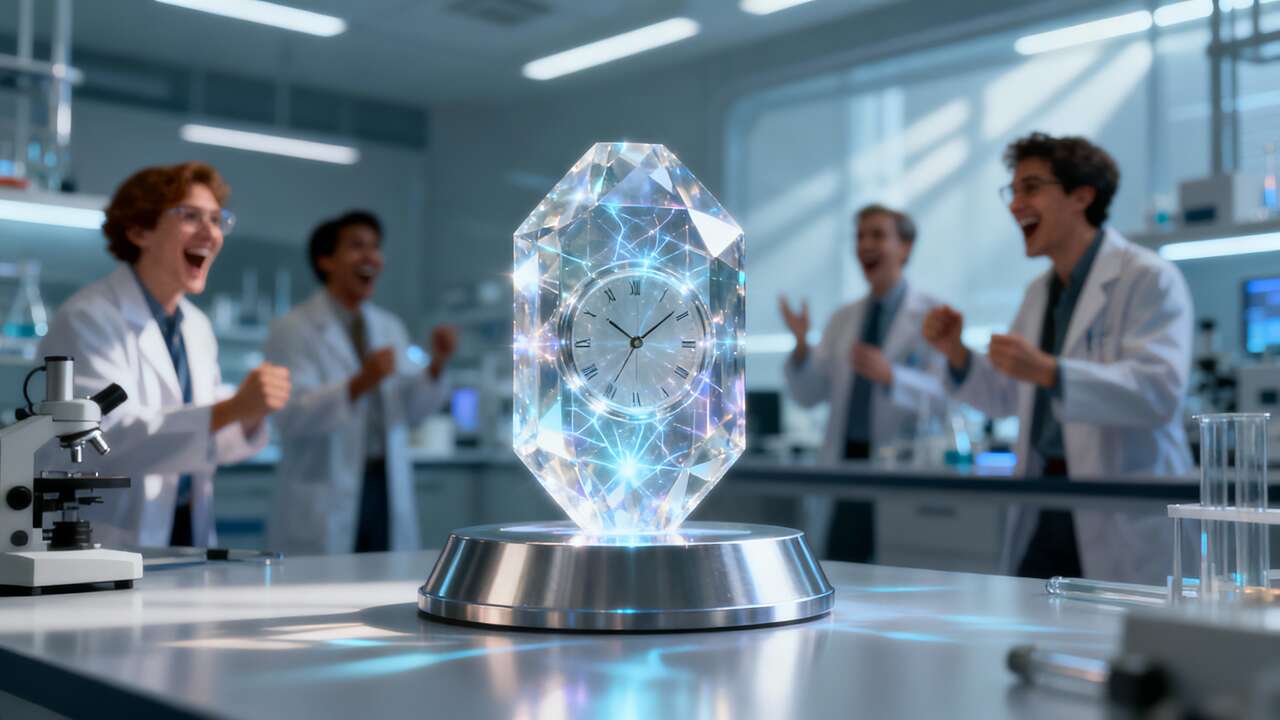

In a development that blurs the line between science fiction and tangible reality, physicists have succeeded in creating a new state of matter that was, until now, purely theoretical. For the first time, a time crystal has been engineered that is large enough and stable enough to be observed by the human eye. This groundbreaking achievement, detailed in a September 2025 paper in the journal Nature Materials, presents a mesmerising spectacle of neon-coloured bands in perpetual, rhythmic motion, offering an unprecedented window into the quantum world and heralding a new era of technological possibility.
Revolutionary Discovery: the First Visible Time Crystal
A Landmark Scientific Achievement
A research team at a major American university has achieved what many in the physics community thought was years, if not decades, away. They have successfully synthesised a time crystal that can be seen, a feat that fundamentally changes our interaction with this exotic phase of matter. The discovery is not merely an incremental step but a giant leap, transforming an abstract quantum concept into a physical object of study. The crystal manifests as a series of vibrant, oscillating stripes, a dynamic pattern that persists without any further input of energy, seemingly defying conventional expectations of thermal equilibrium.
From Microscopic Wonder to Macroscopic View
The visual characteristics of this new creation are as stunning as the science behind it. Under a microscope, the material comes alive with what the researchers describe as “psychedelic tiger stripes”. These bands of neon colour pulse and shift in a perfectly periodic rhythm. Under specific conditions of lighting and scale, these patterns become large enough to be perceived with the naked eye, a truly remarkable accomplishment. It marks the first time a collective quantum phenomenon of this nature has been made directly observable without the need for complex detection equipment, opening the door for more intuitive and direct investigation.
This ability to directly observe the crystal’s behaviour provides a powerful tool for understanding its fundamental properties. The visual nature of the discovery now allows scientists to explore how these strange materials behave in real time, a crucial step in unlocking their full potential.
What Is a Time Crystal ?
A New Dimension of Order
To grasp the significance of a time crystal, one must first understand the nature of a conventional crystal. Materials like diamonds, salt, or quartz are defined by their highly ordered atomic structure, a lattice of particles that repeats in the three dimensions of space. This spatial periodicity is what gives them their characteristic shapes and properties. A time crystal, first theorised by an American physicist in 2012, extends this concept of order into a fourth dimension: time. Its constituent particles are locked in a state of perpetual, synchronised oscillation, meaning its structure repeats itself at regular temporal intervals, not just in space.
Challenging the Laws of Physics
The initial proposal for time crystals was met with considerable scepticism. Some physicists argued that such a structure, which exhibits motion in its lowest-energy state, might violate the fundamental principles of thermodynamics. However, subsequent research clarified that these are non-equilibrium systems, continuously driven by an external source (like light in this recent experiment) but locked into a periodic motion with a frequency different from the drive itself. They do not generate energy from nothing but rather exhibit a novel and robust form of temporal order. This discovery confirms that this bizarre state of matter is not just a theoretical curiosity but a real, physical phenomenon.
Comparing States of Matter
The distinction between spatial and temporal order is fundamental. The table below highlights the key differences between a regular, spatial crystal and the newly realised time crystal.
| Property | Regular Crystal (e.g., Diamond) | Time Crystal |
|---|---|---|
| Repeating Pattern | In space (3D lattice) | In time (periodic oscillation) |
| State of Equilibrium | Exists in its ground state at thermal equilibrium | Exists in a non-equilibrium, driven state |
| Behaviour at Rest | Stationary and static | Perpetual, synchronised motion |
| Example | Salt, snowflakes, minerals | Light-induced oscillating liquid crystals |
Understanding this new form of organised matter requires a significant shift in perspective, moving from a static view of crystal structures to a dynamic one. The methods used to create this visible time crystal are just as innovative as the object itself.
Creating the Time Crystal Using Light
Harnessing Liquid Crystals
The key to this breakthrough lies in the choice of material. The research team turned to liquid crystals, a unique state of matter that shares properties of both conventional liquids and solid crystals. These are the same types of materials used in the ubiquitous liquid crystal displays (LCDs) found in smartphones, televisions, and computer monitors. Their molecules can flow like a liquid but can also be aligned in a crystal-like way. This dual nature makes them exceptionally responsive to external stimuli, such as electric fields or, in this case, light.
The Photo-Induction Process
The creation process is elegantly simple in concept yet complex in execution. The scientists illuminated the thin film of liquid crystals with a laser. This constant input of light energy acts as a “pump”, driving the system out of equilibrium. In response, the molecules within the liquid crystal begin to self-organise and move in a coordinated, repetitive pattern. This is not a simple reaction to the light but the emergence of a new, stable state of matter. The crystal’s oscillations occur at a specific, regular frequency that is a sub-harmonic of the driving laser’s frequency, a key signature that confirms its identity as a genuine time crystal. It is this emergent, collective dance of molecules, powered by light, that gives rise to the visible, pulsating stripes.
The ability to use light to generate and control the time crystal is a significant advantage, suggesting that future applications could be integrated into existing optical and photonic systems. This level of control has made it possible to capture the phenomenon on video for the first time.
First Video Demonstration of a Time Crystal
Capturing Perpetual Motion
For the first time, the ethereal dance of a time crystal has been recorded, providing irrefutable visual proof of its existence and behaviour. The video footage shows the neon-coloured bands materialising and beginning their rhythmic, synchronised movement across the liquid crystal film. This is not a computer simulation or an artist’s impression; it is a direct recording of a quantum phenomenon unfolding at a macroscopic scale. The steady, unwavering pulse of the patterns provides a compelling demonstration of the crystal’s temporal order and its remarkable stability over time.
The Importance of a Visual Record
Having a video demonstration is a game-changer for the field. It demystifies the concept of a time crystal, transforming it from a series of complex equations into something tangible and observable. This visual evidence serves several crucial purposes:
- Validation: It offers clear, unambiguous proof that validates the theoretical predictions and experimental results.
- Education: It makes the phenomenon accessible to a broader audience, including students, the public, and scientists in other disciplines.
- Research: It allows for detailed analysis of the crystal’s dynamics, such as how patterns form, interact, and respond to changes in the environment.
The ability to see and analyse this behaviour directly will accelerate research and development, particularly in exploring the practical applications these unique properties might enable.
Future Implications of Visible Time Crystals
A New Frontier for Technology
The unique properties of a visible time crystal, particularly its stable, periodic behaviour and its visual signature, open up a wealth of potential applications across various technological domains. The ability to create a dynamic, difficult-to-replicate pattern has immediate implications for security. Furthermore, its inherent rhythm could be harnessed for new forms of information processing and storage. The research team has already suggested several promising avenues where this technology could make a significant impact.
Potential Real-World Applications
The transition from laboratory curiosity to practical tool is already being mapped out. Some of the most exciting potential uses include:
- Anti-counterfeiting measures: The unique, dynamic visual patterns of a time crystal could be embedded into high-value items like currency, passports, or luxury goods. Replicating such a living pattern would be virtually impossible, providing an unparalleled level of security.
- Random number generators: The inherent quantum fluctuations within the crystal could be harnessed to create truly random number generators, which are essential for cryptography and secure communications.
- Advanced data storage: The oscillating patterns could be used to create novel two-dimensional barcodes or other forms of optical data storage, encoding information in dynamic, time-varying patterns.
- Quantum computing: While more speculative, the stable, periodic nature of time crystals could potentially be used to create more robust qubits, the fundamental building blocks of quantum computers, protecting them from environmental noise.
These applications, however, depend on overcoming the scientific and engineering hurdles that still stand in the way.
Scientific Challenges and Research Perspectives on Time Crystals
From Laboratory to Industry
While the creation of a visible time crystal is a monumental success, the path to practical application is paved with challenges. One of the primary hurdles is stability and scalability. The current experiments are conducted in highly controlled laboratory settings. Researchers must now work to create time crystals that can remain stable under a wider range of conditions, including varying temperatures and exposure to environmental interference. Furthermore, methods for producing these materials on a larger scale, and integrating them into existing devices, need to be developed.
The Next Wave of Research
The future of time crystal research is incredibly bright and will likely proceed along several parallel tracks. Scientists will explore different material systems beyond liquid crystals to see if time crystals can be created with other properties. A deeper theoretical understanding of how these non-equilibrium systems operate is also needed to fully predict and control their behaviour. The ultimate goal is to move from simply observing these fascinating objects to engineering them with specific frequencies, patterns, and lifetimes, custom-tailored for the technological applications of tomorrow.
This discovery has not only solved a long-standing challenge in physics but has also laid the foundation for a new field of materials science. The creation of a visible time crystal is a powerful demonstration of how quantum mechanics can manifest in our macroscopic world. It serves as a vivid reminder that the universe still holds fundamental secrets, and their discovery has the potential to reshape our technology and our understanding of reality itself.

- “Trees Adjacent to Fault Lines Reveal Low-Frequency Vibrations Ahead of Seismic Events” - 20 November 2025
- I’ve Recommended It to My Patients for Years”: The Right Way to Wash Your Hair With Vinegar, According to a Dermatologist - 20 November 2025
- Earth’s Seasons Are Out of Sync, Scientists Discover from Space - 20 November 2025
Related publications:
 My Grandma Was Right” Chefs Reveal the Forgotten Trick to Cook Fried Eggs Without Sticking Using No Oil and No Water at All
 Taller Than Charles de Gaulle: turkey Transforms Naval Power with Revolutionary Project
 How Bay Leaves Can Make You Look Younger: visible Results in Days
 Veterinarians Warn: The Home Remedy That Eliminates Fleas Effectively
 Retiring in the Sun: the European Country Offering a Luxurious Lifestyle for Just €750 a Month
 Step Aside Frying Pans: discover Oil-Free Cooking with Even-Heat Magnetic Surfaces
 How to Iron Clothes Faster Using a Spray Bottle and a Secret Ingredient
 They’re Building ICBMs With Carbon Fiber”: North Korea Tests 443,000-Pound Engine While America Races