
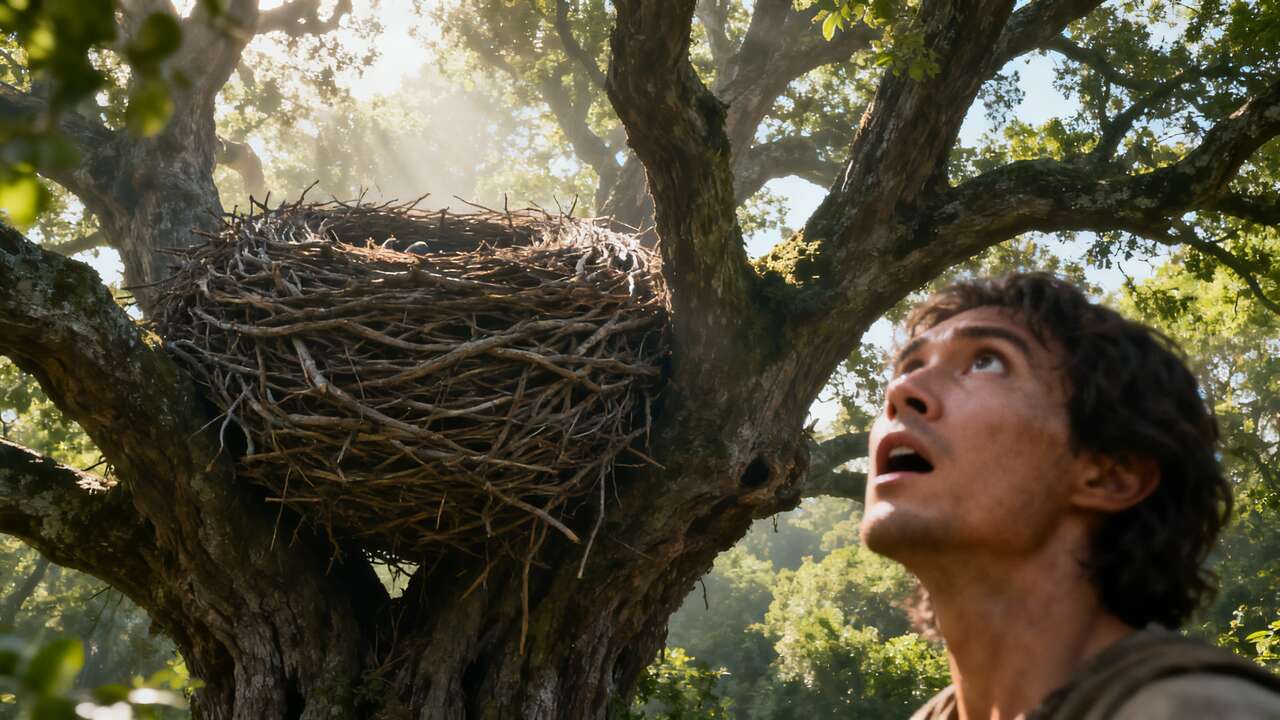

In the world of natural architecture, few structures command as much awe as those built by birds. While many are marvels of intricate design, one particular creation stands alone, not for its delicacy, but for its sheer, staggering mass. Documented by scientists, the largest bird nest ever recorded was a colossal structure, a testament to the relentless engineering of its avian builders, weighing more than a small family car and defying the very limits of what one might imagine a nest to be.
A nest weighing over two tonnes: a world record
The incredible eagle’s nest: the largest ever documented
The distinction of building the world’s most massive nest belongs to a pair of Haliaeetus leucocephalus, more commonly known as bald eagles. This extraordinary structure was officially examined and documented, tipping the scales at an estimated weight of more than two tonnes. To put this into perspective, its weight is equivalent to approximately 4,400 pounds. This is not merely a large nest; it is a monumental feat of construction that has held the world record for decades, serving as a benchmark against which all other avian structures are measured. Its existence pushes the boundaries of our understanding of animal behaviour and their capacity for long-term, large-scale projects.
Key figures of a colossal structure
The raw numbers associated with this nest are difficult to comprehend without comparison. Its dimensions and weight paint a picture of a structure built with unparalleled dedication over a significant period. The official measurements, taken when the nest was studied, reveal the true scale of this natural wonder. Here is a breakdown of its vital statistics:
| Measurement | Value (Metric) | Value (Imperial) |
|---|---|---|
| Width | 2.9 metres | 9.5 feet |
| Depth | 6 metres | 20 feet |
| Estimated Weight | Over 2 tonnes | ~4,400 pounds |
These figures confirm its status as an ornithological outlier. The nest was not just a temporary shelter but a permanent, ever-expanding fortress, a legacy built stick by stick. The story of its discovery sheds further light on this remarkable natural phenomenon.
Discovery in Florida: a pair of bald eagles at work
A landmark observation near St. Petersburg
The record-breaking nest was located in a setting that is classic for bald eagles: near a source of water in a tall, sturdy tree. Specifically, this avian masterpiece was found near St. Petersburg, Florida. The discovery was not a fleeting glimpse but a subject of scientific study, culminating in its formal examination in 1963. The architects were a dedicated pair of bald eagles who, year after year, returned to their home to add more material, reinforcing and expanding their creation. This consistent effort is what allowed the nest to reach such a gargantuan size, becoming a local landmark and eventually a global record-holder.
The context of the examination
When scientists formally documented the nest, they were not just measuring a curiosity; they were studying a living example of animal behaviour at its most extreme. The process involved carefully estimating its dimensions and calculating its immense weight. The structure was composed of a dense matrix of sticks, branches, and other vegetation, compacted over many years. The sheer depth of six metres indicated a long history of occupation. This scientific verification was crucial, as it moved the nest from the realm of local legend into the official annals of zoology, cementing its place as the largest bird nest ever recorded. This architectural accomplishment is even more impressive when considering its specific dimensions.
The impressive dimensions of the nest: an architectural feat
Astonishing dimensions
To truly appreciate the scale of the Florida eagle nest, one must visualise its dimensions. With a width of 2.9 metres, it was wider than many modern cars are long. Its depth of six metres is perhaps even more staggering, equivalent to the height of a two-storey building. This was not a simple cup-shaped nest but a deep, cylindrical fortress. The interior would have been a complex, layered structure, with newer material added to the top each breeding season. The sheer volume of material required to build and maintain such a nest is immense, involving thousands of journeys by the eagle pair to collect sticks, branches, and soft lining materials like moss and grass.
A testament to avian engineering
The construction of this nest represents an incredible display of natural engineering. The eagles had to select a tree with branches strong enough to support the ever-increasing weight. The interlocking branches and sticks formed a stable base, while the sheer mass provided insulation and protection from the elements and predators. This was not just a home but a multi-generational fortress, built to last. The structural integrity required to keep a two-tonne mass secure at the top of a tree, weathering storms and the passage of time, highlights the innate architectural skills of these birds. Such dedication to a single nesting site is a hallmark of their species.
A look back at the nesting habits of bald eagles
Annual renovation and expansion
The primary reason this nest reached such epic proportions is a core behaviour of bald eagles known as site fidelity. Mated pairs often return to the same nest year after year. Each breeding season, they engage in a process of renovation and expansion, adding a new layer of sticks and fresh lining. This annual addition can add up to 30 centimetres (one foot) in height and a significant amount of weight each year. Over decades, a modest starter nest can evolve into a colossal structure like the one found in Florida. This behaviour is a long-term investment in their offspring’s safety and their own reproductive success.
Strategic location and habitat
The choice of a nesting site is critical for bald eagles. They exhibit clear preferences that maximise their chances of survival and successful hunting. Key features of an ideal eagle nesting site include:
- Proximity to water: Nests are almost always located near rivers, lakes, or coastlines, which are their primary hunting grounds for fish.
- Height and visibility: They build their nests high up in the canopies of tall, mature trees, providing an excellent vantage point for spotting prey and predators.
- Sturdy support: The chosen tree must have a strong structure, typically with a prominent fork in the branches, to support the nest’s immense weight.
This strategic selection is evident across their natural habitat, which spans most of North America, from Canada and Alaska down to northern Mexico.
Comparison with other impressive nests
While the bald eagle nest holds the record for the largest nest built by a single pair of birds, other species are also known for their impressive constructions. For instance, the sociable weaver of southern Africa builds massive communal nests that can house hundreds of birds. In Australia, the malleefowl constructs enormous incubation mounds not from sticks, but from soil and rotting vegetation. These mounds can reach up to 4.57 metres in height and weigh an astonishing 300 tonnes. However, these are different types of structures. The Florida nest remains the largest tree-based nest ever documented, a singular achievement of a single pair, reflecting their unique perseverance.
Natural engineering: a tribute to the perseverance of eagles
The devotion of a pair
Behind the statistics and records lies a story of remarkable partnership. Bald eagles are known for forming strong, monogamous bonds that often last for life. The construction and maintenance of their nest is a joint effort, a shared project that strengthens their bond. The male and female work in tandem, one gathering materials while the other arranges them. This cooperative spirit, sustained over many years, is the driving force behind the creation of such a monumental home. The nest is more than just a place to lay eggs; it is the physical manifestation of their enduring partnership and devotion.
A symbol of strength and stability
Ultimately, the great eagle nest of St. Petersburg stands as a powerful symbol. It represents the strength and stability of the natural world and the incredible capabilities of its inhabitants. In an era where many natural habitats are under threat, this story serves as a reminder of the wonders that can be achieved when wildlife is given the space and time to thrive. The eagles’ perseverance in building their home, stick by stick, year after year, is a profound lesson in patience and dedication, showcasing an instinct for engineering that rivals any human endeavour in its own context.
The record-breaking nest built by a pair of bald eagles near St. Petersburg is a true marvel of the animal kingdom. Its immense weight of over two tonnes and its towering dimensions stand as a world record, showcasing an extraordinary example of avian architecture. This structure was the result of the eagles’ innate nesting behaviour, where pairs return to the same site annually, continually adding materials and expanding their home. More than just a collection of sticks, this colossal nest symbolises the incredible perseverance, engineering skill, and enduring partnership of these magnificent birds of prey.

- “Trees Adjacent to Fault Lines Reveal Low-Frequency Vibrations Ahead of Seismic Events” - 20 November 2025
- I’ve Recommended It to My Patients for Years”: The Right Way to Wash Your Hair With Vinegar, According to a Dermatologist - 20 November 2025
- Earth’s Seasons Are Out of Sync, Scientists Discover from Space - 20 November 2025
Related publications:
 How Bay Leaves Can Make You Look Younger: visible Results in Days
 How to Save Money on Heating by Bleeding Radiators Correctly
 Retiring in the Sun: the European Country Offering a Luxurious Lifestyle for Just €750 a Month
 Step Aside Frying Pans: discover Oil-Free Cooking with Even-Heat Magnetic Surfaces
 Scientists Find That Boiling Orange Peel Releases Antioxidants That Purify The Air Indoors
 How to Iron Clothes Faster Using a Spray Bottle and a Secret Ingredient
 8 Songs From the 60s and 70s That Make People 60+ Feel 19 Again and Trigger Emotional Nostalgia
 A Simple Roll of Newspaper Is Enough: The Forgotten Method That Carries Your Geraniums Through Winter Without Water, Without Soil… and Without Spending a Penny