
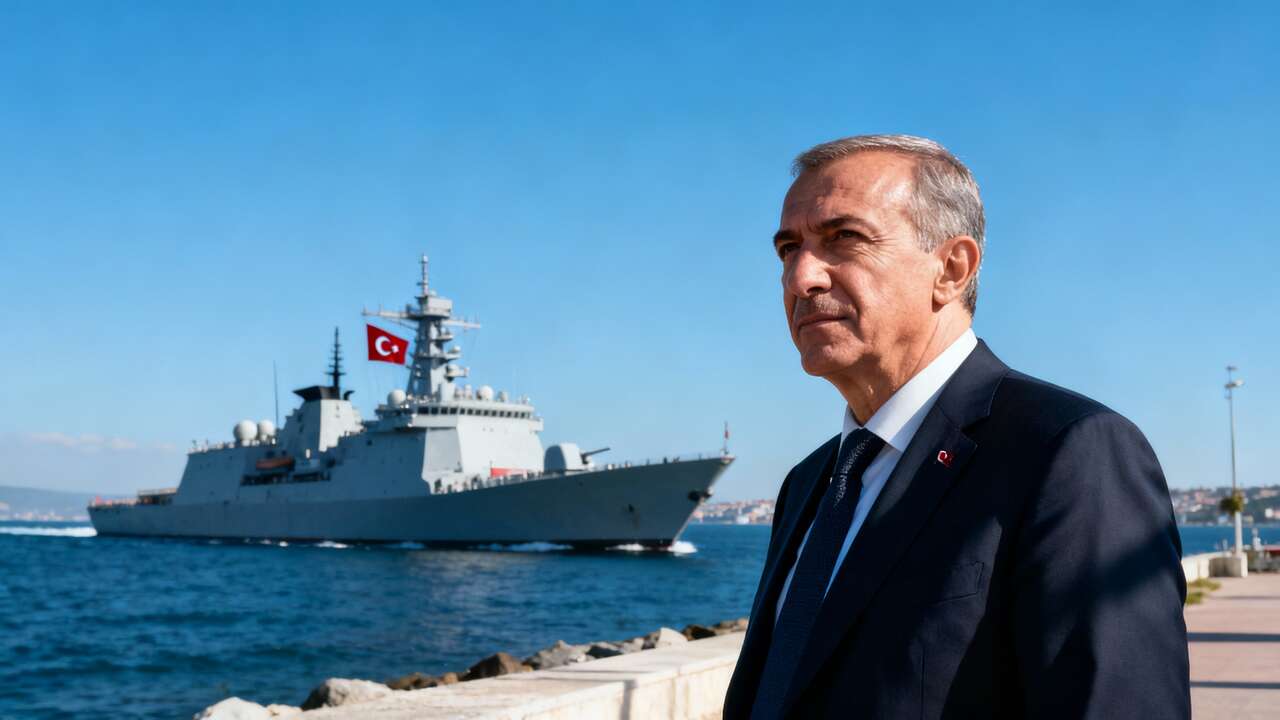

In a move signalling a profound shift in global maritime power, turkey is charting a course to join the elite club of nations capable of building and deploying large aircraft carriers. The nation’s defence industry, buoyed by recent successes, is embarking on an ambitious project to construct a national aircraft carrier that aims not only to rival but potentially surpass the capabilities of established European flagships like the French Charles de Gaulle. This initiative is not an abrupt development but the culmination of a deliberate, long-term strategy, underscored by the recent commissioning of the TCG Anadolu, a vessel that serves as both a testament to current capabilities and a stepping stone towards a more formidable naval future.
Naval challenge: turkey surpasses the Charles de Gaulle
The TCG Anadolu as a strategic forerunner
The TCG Anadolu, which entered service in 2023, represents a critical first step in turkey’s naval aviation ambitions. While officially classified as an amphibious assault ship, its design and operational focus have firmly established it as the world’s first dedicated drone carrier. This vessel is not merely a platform for helicopters and landing craft; it is a laboratory for the future of naval warfare, pioneering the deployment of a new generation of unmanned aerial vehicles. The ship is designed to operate cutting-edge drones, including:
- The Bayraktar TB3: a naval version of the world-renowned TB2, adapted for short take-off and landing (STOL) operations from a carrier deck.
- The Kızılelma: a jet-powered, low-observable unmanned combat aerial vehicle (UCAV) currently in its testing phase, promising to bring advanced strike and reconnaissance capabilities to the fleet.
This iterative approach, using the Anadolu to test and refine drone operations at sea, demonstrates a pragmatic and forward-thinking strategy, allowing the turkish navy to build expertise before committing to a larger, more complex platform.
A new class of carrier on the horizon
Building on the experience gained from the Anadolu, Turkish defence officials have confirmed plans for a significantly larger and more capable “national aircraft carrier”. The ambition is clear: to create a vessel that exceeds the specifications of the Charles de Gaulle. This objective goes beyond simple metrics of size and displacement. The project envisions a carrier with a greater aircraft capacity and a design philosophy that fully integrates the lessons of modern naval conflict, particularly the central role of unmanned systems. This future flagship is intended to be a symbol of national sovereignty and technological prowess, cementing turkey’s status as a premier naval power.
A statement of strategic intent
The decision to benchmark this new project against a vessel as significant as the Charles de Gaulle is a powerful geopolitical statement. The French carrier is a cornerstone of European defence and a symbol of naval power projection. By openly aiming to surpass it, turkey is signalling its intent to challenge the established maritime order and assert itself as a key player not just in its immediate region, but on the wider international stage. This is a direct challenge to the naval hierarchy that has dominated for decades.
This bold statement of intent is underpinned by a project designed to fundamentally alter the strategic calculus in one of the world’s most critical maritime crossroads.
A project set to transform the Mediterranean
Redefining naval presence and power projection
The introduction of a large-deck aircraft carrier into the Turkish navy’s order of battle would revolutionise its capacity for power projection. Such a vessel would grant an ability to establish air superiority and conduct strike operations far from its home shores, without reliance on land-based airfields or the permission of other nations for overflight rights. In the contested waters of the eastern Mediterranean and the Black Sea, a carrier strike group would provide a persistent and mobile military presence, significantly enhancing turkey’s influence over strategic sea lanes, energy exploration zones, and regional conflicts. It represents a shift from a coastal defence force to a navy with true blue-water capabilities.
Fueling a national industrial and technological base
The construction of an aircraft carrier is one of the most complex industrial undertakings a nation can attempt. The project will serve as a powerful catalyst for turkey’s domestic defence industry, driving innovation and creating thousands of skilled jobs. The “Made in Turkey” philosophy is central to this endeavour, with a high percentage of the ship’s systems, from its combat management software to its sensors and weaponry, being developed and produced locally. This not only ensures technological sovereignty but also positions turkey as a top-tier exporter of advanced naval systems, further boosting its economy and international standing.
A catalyst for a new regional dynamic
Ankara’s naval expansion is unlikely to occur in a vacuum. The development of a Turkish carrier will invariably compel other regional powers, such as Greece and Egypt, to reassess their own naval doctrines and procurement plans. This could trigger a new phase of naval modernisation across the region as nations seek to maintain a strategic balance. While this could raise tensions, it also underscores the transformative impact of turkey’s project, forcing a region-wide re-evaluation of maritime security and naval strategy for the 21st century.
The success of this transformative project hinges on the nation’s ability to harness and develop cutting-edge systems, a domain where it has already demonstrated remarkable progress.
Advanced technology: turkey’s major asset
Pioneering the drone carrier concept
Turkey’s primary technological advantage lies in its world-leading development of unmanned systems. While other navies are exploring the integration of drones, turkey is the first to build its carrier doctrine entirely around them. The new national carrier will likely feature a hybrid air wing but with a heavy emphasis on UCAVs. This approach offers several distinct advantages:
- Reduced risk: deploying unmanned systems for high-threat missions eliminates the risk of losing pilots.
- Lower costs: UCAVs are generally cheaper to procure, operate, and maintain than their manned counterparts.
- Enhanced endurance: drones can stay on station for far longer than manned aircraft, providing persistent surveillance and strike capability.
- Innovative tactics: the ability to deploy drone swarms and networked unmanned platforms opens up entirely new tactical possibilities that could overwhelm traditional air defence systems.
This focus on unmanned technology is not a compromise but a deliberate strategic choice to leapfrog conventional naval aviation models.
Strengthening indigenous capabilities
The carrier project is a showcase for turkey’s indigenous defence ecosystem. Companies like Baykar, Turkish Aerospace Industries (TAI), Aselsan, and Havelsan are at the forefront of developing the critical technologies required. From the aircraft launch and recovery systems, rumoured to be an indigenous electromagnetic catapult (EMALS) equivalent, to the advanced radar and electronic warfare suites, the emphasis is on self-sufficiency. This insulates the project from the vagaries of international politics and potential arms embargoes, ensuring its completion and operational independence.
A design for the future
The design philosophy for the new carrier is inherently forward-looking. Unlike legacy carriers that were designed in a different era, the Turkish vessel is being conceived from the ground up to operate in a modern, network-centric battlespace. It is expected to feature a highly automated command and control system, robust cyber defences, and a modular design that will allow for the seamless integration of future technologies, such as directed energy weapons or hypersonic missiles. It is being built not just for the challenges of today, but for the conflicts of tomorrow.
This technological prowess directly translates into significant geopolitical weight, with wide-ranging consequences for the entire region.
Strategic implications for the Mediterranean basin
Altering the balance of power
The deployment of a Turkish aircraft carrier will fundamentally alter the strategic map of the Mediterranean. It will provide Ankara with a powerful tool to enforce its claims in disputed maritime zones, particularly concerning energy resources in the eastern Mediterranean. This newfound capability will shift the military balance with regional rivals and could reshape existing alliances. Turkey’s position within NATO will also be transformed; it will become a more capable and indispensable ally for the alliance’s southern flank, but also a more independent actor, able to pursue its national interests with greater assertiveness.
Securing strategic maritime routes
Control of the seas remains paramount for trade and energy security. A carrier strike group gives a nation the ability to protect its own maritime trade and, if necessary, interdict that of its adversaries. Operating in the nexus between Europe, Asia, and Africa, the Turkish navy will be able to exert influence over some of the world’s most vital sea lanes of communication, including the approaches to the Suez Canal and the Turkish Straits. This capability provides significant strategic leverage in both peacetime and crisis situations.
A new variable in regional security
The carrier project introduces a new and powerful variable into the complex security environment of the Mediterranean and Black Sea. It enhances turkey’s ability to project power into North Africa and the Middle East, making it a more influential player in regional conflicts. For NATO, a more powerful Turkish navy is a double-edged sword. It strengthens the alliance’s overall posture against potential threats, but it also increases the potential for friction should Turkish strategic objectives diverge from those of its allies, demanding a new level of coordination and deconfliction within the alliance.
As turkey prepares to join this exclusive club, it is natural to measure its ambitions against the benchmarks set by the world’s leading naval forces.
Comparison with international naval giants
A comparative analysis of carrier capabilities
To understand the scale of turkey’s ambition, it is useful to compare the projected specifications of its future national aircraft carrier with those of existing flagships. While the final design is still under wraps, official statements and industry analysis provide a basis for a tentative comparison.
| Feature | Future Turkish Carrier (Projected) | Charles de Gaulle (France) | TCG Anadolu (Turkey) |
|---|---|---|---|
| Displacement | ~60,000 tonnes | 42,500 tonnes | 27,436 tonnes |
| Length | ~285 metres | 261.5 metres | 231 metres |
| Propulsion | Conventional (Gas Turbine) | Nuclear | Conventional (Diesel-Electric) |
| Aircraft Launch System | STOBAR or CATOBAR (EMALS type) | CATOBAR (Steam Catapults) | Ski-jump (STOVL/STOL) |
| Primary Air Wing | Manned fighters (e.g., Kaan) & UCAVs (e.g., Kızılelma) | Rafale M fighters, E-2C Hawkeye | UAVs/UCAVs (Bayraktar TB3, Kızılelma) & Helicopters |
A fundamentally different operational doctrine
The table highlights key differences, but the most significant distinction lies in operational philosophy. The US Navy’s supercarriers are designed for global power projection with large wings of advanced manned fighters. The Charles de Gaulle serves a similar, albeit smaller-scale, role. Turkey, however, is pioneering a new model. Its future carrier will be built around a synergy between manned and unmanned systems, leveraging the strengths of drones for reconnaissance, electronic warfare, and high-risk strike missions. This drone-centric approach is a unique and potentially game-changing innovation in naval aviation.
The cost-versus-capability calculation
Building a supercarrier is prohibitively expensive for most nations. By focusing on a conventional propulsion system and leveraging its cost-effective yet highly capable domestic drone technology, turkey aims to achieve a formidable level of power projection at a fraction of the cost of a nuclear-powered American or French counterpart. This pragmatic approach seeks to maximise strategic impact within the constraints of its national budget, creating a highly capable asset tailored specifically to its regional security needs and ambitions.
This strategic investment is not a singular event but part of a broader vision for the long-term evolution of the nation’s maritime forces.
Future prospects for the Turkish navy
The journey to a blue-water navy
The national aircraft carrier project is the centrepiece of the Turkish navy’s transformation from a green-water force, primarily focused on its coastal waters, into a true blue-water navy. A blue-water navy is defined by its ability to conduct sustained, independent operations across the open oceans. The carrier strike group, comprising the aircraft carrier itself along with a screen of modern frigates, destroyers, and support ships, will be the ultimate expression of this capability, enabling turkey to protect its interests and project influence far from its home ports.
Overcoming significant challenges
The path to a fully operational carrier capability is fraught with challenges. The financial investment required will be immense, stretching the national defence budget for years to come. The technological hurdles, from developing a reliable aircraft launch system to integrating a complex web of sensors and weapons, are substantial. Perhaps most critically, the human element cannot be overlooked. Training the thousands of sailors, aviators, and technicians required to operate a carrier strike group to a high standard of proficiency is a multi-generational effort that requires a sustained national commitment.
The roadmap ahead
The next decade will be crucial for the Turkish navy. The immediate future will involve finalising the carrier’s design and selecting the primary contractors. This will be followed by the keel-laying ceremony, a symbolic moment marking the start of construction. As the hull takes shape, parallel efforts will focus on developing the carrier’s air wing, including the navalisation of the indigenous Kaan fighter jet and the maturation of the Kızılelma UCAV. The journey will be long and complex, but the strategic direction is now firmly set.
Turkey’s naval ambition, crystallised in the plan for a national aircraft carrier, is a clear indicator of its rising geopolitical stature. This project is more than the construction of a ship; it is the forging of a new strategic tool intended to reshape the maritime balance of power. By blending proven shipbuilding techniques with pioneering drone technology, turkey is not merely seeking to join the ranks of naval powers but to redefine what a 21st-century carrier can be, heralding a new era for its navy and the wider Mediterranean region.

- “Trees Adjacent to Fault Lines Reveal Low-Frequency Vibrations Ahead of Seismic Events” - 20 November 2025
- I’ve Recommended It to My Patients for Years”: The Right Way to Wash Your Hair With Vinegar, According to a Dermatologist - 20 November 2025
- Earth’s Seasons Are Out of Sync, Scientists Discover from Space - 20 November 2025
Related publications:
 No Plastic Wrap, No Plastic Containers: The Trick to Stop Ham and Cheese from Drying Out Once Opened
 Goodbye to the Ikea Convertible: This Trendy Sofa Bed at a Low Price Is Already Winning Over Decor Lovers Everywhere
 Veterinarians Warn: The Home Remedy That Eliminates Fleas Effectively
 These Are 6 Products You Don’t Want To Miss From The New M&S X Tom Kerridge Cookware Collection.
 How to Save Money on Heating by Bleeding Radiators Correctly
 Honda Gold Wing 2025 Official Reveal Proudly Showcases Its Legendary Touring Heritage With Revolutionary Powertrain and Luxurious Comfort Options
 How to Iron Clothes Faster Using a Spray Bottle and a Secret Ingredient
 They’re Building ICBMs With Carbon Fiber”: North Korea Tests 443,000-Pound Engine While America Races