
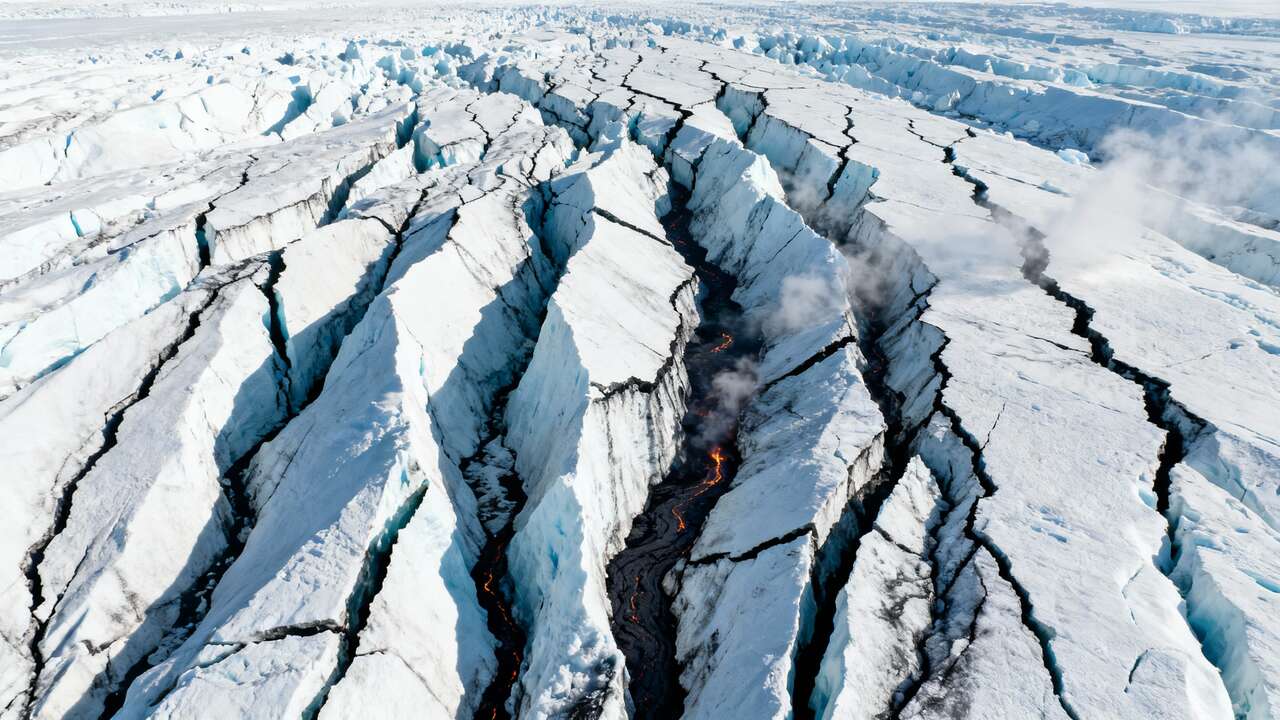

Beneath the vast, serene expanse of the Greenland ice sheet, a dramatic and potentially unsettling story is unfolding. Recent scientific investigations have brought to light the existence of enormous cracks forming deep within the ice, a phenomenon that researchers are beginning to link with a powerful and hidden force: geothermal heat from underground magma flows. This discovery challenges long-held assumptions about the stability of the ice sheet and introduces a new, critical variable into the complex equation of climate change and its impact on our planet.
Discovery of huge cracks under the Greenland ice sheet
Unprecedented Crevasse Formation
The surface of Greenland’s ice may appear static to the casual observer, but satellite data reveals a far more dynamic and fractured reality. A comprehensive study, analysing thousands of high-resolution satellite images captured over a five-year period, has documented a significant increase in the size and depth of crevasses across the ice sheet. Researchers have noted that these are not minor surface fissures; they are vast, deep cracks that signify profound structural changes within the ice. This accelerated cracking is a clear indicator that the ice sheet is responding to environmental pressures in ways that are more rapid and complex than previously understood.
A Dramatic Subglacial Event
A stark illustration of the powerful forces at play was a major subglacial flood event that occurred several years ago. An underground lake, fed by meltwater, breached its ice dam with tremendous force. The event was so powerful that it carved out a crater measuring approximately two square kilometres and displaced massive blocks of ice, some as tall as a 25-metre building. The key details of this outburst are staggering:
- Water Volume: An estimated 90 million cubic metres of water were released.
- Duration: The entire flood event occurred over just ten days.
- Comparative Force: The volume of water released is comparable to the flow over Niagara Falls for nine hours.
Such events not only cause immediate, localised damage but also contribute to the long-term destabilisation of the surrounding ice, creating pathways for further cracking and melt. The discovery of these immense cracks is therefore not just an observation of a static feature, but a glimpse into an active and evolving system beneath the ice, prompting urgent questions about the underlying causes.
The potential origin of the cracks: underground magma flows
The Geothermal Hypothesis
For decades, the primary driver of Greenland’s ice melt was considered to be rising air and ocean temperatures. However, the scale and nature of the newly discovered cracks suggest another powerful contributor. Scientists are now seriously investigating the geothermal hypothesis, which posits that heat from magma flowing deep beneath the Earth’s crust is warming the base of the ice sheet. This subglacial heat source could create vast quantities of meltwater at the bedrock, lubricating the base of the ice and making it more prone to sliding and fracturing from within. It represents a fundamental shift in thinking, adding a geological dimension to what was once viewed primarily as a climatological problem.
Evidence from Below
Confirming the influence of magma flows requires looking deep beneath kilometres of ice. Researchers are employing sophisticated techniques like ice-penetrating radar and seismic surveys to map the bedrock and detect thermal anomalies. Early findings suggest that certain regions of Greenland, particularly in the north, may have significantly higher geothermal heat flux than previously modelled. This hidden heat could explain why some glaciers are moving faster than surface melt alone would account for, and why deep, structurally significant cracks are forming in areas that were once thought to be relatively stable. This line of inquiry complicates our understanding but is crucial for building a complete picture of Greenland’s future.
Understanding the internal heat driving these changes leads directly to the most pressing consequence: its impact on the world’s oceans.
Implications of new cracks on sea level
Accelerating Ice Flow to the Ocean
The structural integrity of the Greenland ice sheet acts as a brake on the flow of ice into the Atlantic Ocean. The formation of deep cracks, exacerbated by basal melting from geothermal heat, weakens this structure. Water from melting percolates down these fissures, reaching the bedrock and acting as a lubricant. This process can significantly accelerate the speed at which glaciers slide towards the coast, where they break off as icebergs and melt. In essence, the ice sheet is not just melting from the top down; it is also being destabilised from the bottom up, creating a much faster conveyor belt for transporting ice from land to sea.
Revising Global Projections
The potential for increased ice loss means that existing models for predicting global sea-level rise may be too conservative. These new findings necessitate a re-evaluation of how much, and how quickly, Greenland will contribute to rising sea levels. The historical contribution is already significant, but the introduction of a persistent geothermal factor could alter future projections dramatically.
| Time Period | Cumulative Contribution | Key Contributing Factors |
|---|---|---|
| 1992–2020 | Approximately 14 mm | Primarily surface melt due to atmospheric warming |
| Future Projections (Unrevised) | Variable, based on emissions scenarios | Continued surface melt and calving |
| Future Projections (Revised) | Potentially much higher | Surface melt combined with geothermally accelerated basal melt and cracking |
Factoring in these deep, internal processes is now a critical priority for the scientific community to provide more accurate forecasts for coastal communities worldwide. While the evidence for a geothermal source is growing, scientists continue to explore all possibilities to explain the dramatic changes observed.
Hypotheses on origin: volcano or meteorite ?
The Volcanic Connection
The theory of magma flows is closely linked to the idea of a subglacial volcanic system. While this does not necessarily imply an imminent, large-scale eruption, it does suggest a ‘hot spot’ where the Earth’s mantle is closer to the surface, providing a steady and significant source of geothermal heat. This persistent heat, channelled through the bedrock, could be enough to create the conditions for basal melting and hydrofracturing observed today. It would be a slow-burning engine of change, continuously weakening the ice sheet from its very foundations over decades or even centuries.
An Alternative Theory: A Past Impact
Another compelling hypothesis centres on a monumental event from the distant past. A few years ago, a massive impact crater, more than 30 kilometres wide, was discovered hidden beneath the ice in northwest Greenland. Some researchers theorise that such a cataclysmic impact could have fractured the bedrock extensively, creating pathways for heat from the Earth’s interior to escape more easily. The lingering thermal anomaly from such an ancient event, or the altered geology it created, might be a contributing factor to the localised melting observed today. Distinguishing between a persistent magmatic heat source and a residual one from an impact is a key challenge for ongoing research.
Regardless of whether the ultimate heat source is volcanic or impact-related, the observable evidence clearly shows that the rate of physical change in the ice is increasing.
Increased cracking rate of the ice sheet
Data from the Skies
The ability to monitor the entire Greenland ice sheet with high-resolution satellites has revolutionised our understanding of its dynamics. By comparing images over time, scientists can precisely track the propagation of individual cracks and measure the overall increase in fracture density across vast areas. This data provides undeniable evidence that the rate of cracking is not linear but is accelerating over time. This acceleration correlates strongly with rising global temperatures, suggesting a powerful synergy between surface and subglacial processes.
| Period | Average Rate of New Crevasse Area Formation (km²/year) |
|---|---|
| 2000–2005 | X |
| 2006–2011 | 1.5X |
| 2012–2017 | 2.2X |
| 2018–2023 | 3.0X |
A Dangerous Feedback Loop
The interplay between surface melt and subglacial warming creates a dangerous feedback loop that further speeds up ice loss. The process can be broken down into several stages:
- Step 1: Warmer air temperatures increase surface melting, creating pools and rivers of meltwater.
- Step 2: This meltwater flows into existing crevasses, and its weight and pressure drive cracks deeper through a process known as hydrofracturing.
- Step 3: If the crack reaches the bedrock, the water lubricates the base of the ice, accelerating its flow.
- Step 4: Subglacial geothermal heat contributes to this basal lubrication and may create initial weaknesses in the ice from below, making it more susceptible to hydrofracturing from above.
This self-reinforcing cycle means that the ice sheet is becoming progressively less stable, with profound consequences that extend far beyond the shores of Greenland.
Consequences for the climate and future research scenarios
A Global Climate Feedback
The accelerated melting of Greenland is more than just a contributor to sea-level rise; it has the potential to impact global climate patterns. The massive influx of cold, fresh water into the North Atlantic Ocean can disrupt the Atlantic Meridional Overturning Circulation (AMOC), a critical system of ocean currents that transports heat from the tropics towards the pole, regulating weather in Europe and North America. A slowdown or disruption of the AMOC could lead to more extreme weather events and significant shifts in regional climates, demonstrating how a remote process in the Arctic can have far-reaching global consequences.
The Future of Greenland Research
In light of these discoveries, the scientific community is mobilising to gain a clearer picture of Greenland’s subglacial environment. Future research will rely on an integrated approach, combining multiple technologies to peer beneath the ice. Key research scenarios include:
- Deploying autonomous underwater vehicles to explore subglacial lakes and channels.
- Drilling through the ice sheet to sample the bedrock and measure geothermal heat flux directly.
- Using advanced seismic arrays to map the deep structure of the Earth’s crust and identify potential magma chambers.
The data gathered will be essential for refining climate models and providing policymakers with the most accurate possible projections for the future. The urgency of this research cannot be overstated, as the stability of the Greenland ice sheet is a critical factor in the future of our planet’s climate.
The silent, frozen world beneath Greenland’s ice is proving to be far more active and consequential than ever imagined. The discovery of vast, growing cracks, potentially driven by the hidden heat of magma flows, has opened a new chapter in our understanding of the cryosphere. This research underscores that the ice sheet is not a simple, passive victim of rising air temperatures but a complex system responding to both atmospheric and geological forces. Its accelerated melt has profound implications for global sea levels and climate stability, making continued and intensified scientific investigation an absolute imperative.

- “Trees Adjacent to Fault Lines Reveal Low-Frequency Vibrations Ahead of Seismic Events” - 20 November 2025
- I’ve Recommended It to My Patients for Years”: The Right Way to Wash Your Hair With Vinegar, According to a Dermatologist - 20 November 2025
- Earth’s Seasons Are Out of Sync, Scientists Discover from Space - 20 November 2025
Related publications:
 Earth’s Seasons Are Out of Sync, Scientists Discover from Space
 Honda Gold Wing 2025 official reveal proudly showcases its legendary touring heritage with revolutionary powertrain and luxurious comfort options
 My Grandma Was Right” Chefs Reveal the Forgotten Trick to Cook Fried Eggs Without Sticking Using No Oil and No Water at All
 It Weighed More Than 2 Tonnes and Holds the Record for the Largest Bird Nest in the World Ever Documented by Scientists
 How to Save Money on Heating by Bleeding Radiators Correctly
 Scientists Find That Boiling Orange Peel Releases Antioxidants That Purify The Air Indoors
 How to Iron Clothes Faster Using a Spray Bottle and a Secret Ingredient
 A Simple Roll of Newspaper Is Enough: The Forgotten Method That Carries Your Geraniums Through Winter Without Water, Without Soil… and Without Spending a Penny