
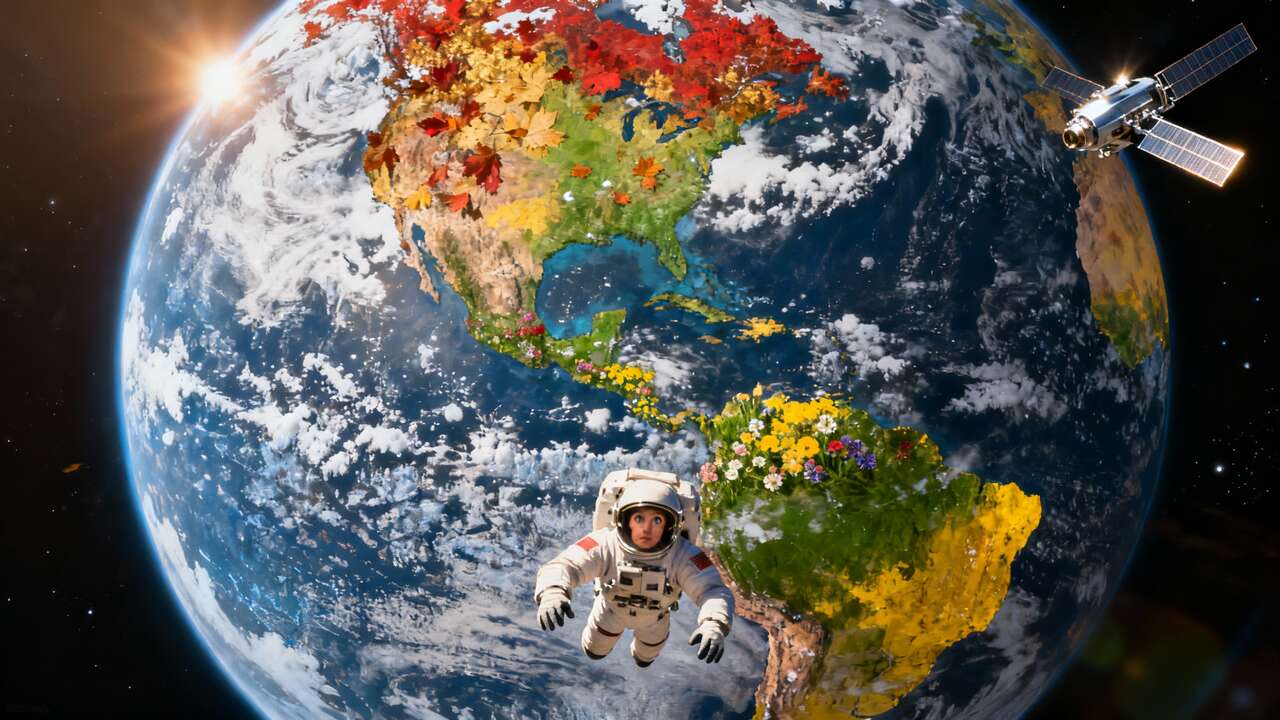

A traditional understanding of our planet often relies on the comforting predictability of four distinct seasons. Yet, recent analysis of extensive satellite imagery has unveiled a far more complex and fragmented reality. Scientists have discovered that across the globe, the familiar rhythms of nature are falling out of step. In numerous regions, the biological timing of spring, summer, autumn, and winter is no longer a synchronised, large-scale event but a patchwork of local variations, a phenomenon with profound implications for ecosystems and human society alike.
Observing the Seasons from Space
The Technological Leap in Earth Observation
For decades, our view of planetary health has been transformed by satellites orbiting high above the atmosphere. This field, known as remote sensing, allows for continuous monitoring of the Earth’s surface, tracking changes in everything from ice cover to urban sprawl. In the study of ecosystems, a key tool has been the measurement of vegetation greenness. By capturing how much infrared light is reflected by plants, scientists can create a global map of plant activity, effectively watching the planet breathe. This has allowed for an unprecedented understanding of large-scale seasonal cycles, such as the annual greening and browning of the northern hemisphere.
From Broad Strokes to Fine Details
Early satellite data provided a revolutionary but broad-brush picture of global seasons. While instrumental in establishing baseline knowledge, the resolution was often too coarse to detect subtle, localised variations. The latest generation of Earth-observation satellites, however, has changed the game. Armed with more sophisticated sensors and higher-resolution imaging capabilities, researchers can now peer into the seasonal dynamics of much smaller areas. This technological advance is the equivalent of moving from a blurry photograph to a high-definition image, revealing intricate details that were previously invisible. The advantages of this new data are numerous:
- Greater spatial resolution: scientists can now distinguish between the seasonal cycles of adjacent valleys or neighbouring hillsides.
- Improved temporal frequency: more frequent satellite passes mean that rapid changes, such as the onset of a spring bloom, can be captured with greater accuracy.
- Enhanced data processing: advanced algorithms can filter out atmospheric interference and analyse decades of archival imagery to identify long-term trends in phenology, the study of the timing of recurring biological events.
This leap in technology has enabled a fundamental reassessment of how seasons function, moving beyond continental patterns to a more nuanced, localised perspective.
The New Satellite Data: a Revelation
Uncovering Hidden Patterns
The analysis of over two decades of this high-resolution satellite data has yielded a startling discovery: seasonal synchrony is not the global norm we once assumed. Instead, the Earth is peppered with regions where the timing of plant growth and dormancy can vary dramatically over very short distances. In these ‘hotspots of asynchrony’, one side of a mountain might experience the onset of its growing season weeks before the other. This finding challenges the foundational model of uniform seasons, suggesting that ecological timekeeping is far more fragmented and locally driven than previously understood. It is a paradigm shift that forces us to reconsider how we model and predict natural cycles.
The Science Behind the Discovery
Researchers meticulously analysed vast datasets, tracking the green-up and senescence of vegetation pixel by pixel across the globe. By comparing the phenological calendars of neighbouring locations, they could map out the degree of seasonal synchrony. Where calendars were closely aligned, the region was deemed synchronous. Where they diverged significantly, it was marked as asynchronous. This systematic approach revealed that while large parts of the world, such as the great plains of North America or the forests of Siberia, do exhibit highly synchronised seasons, other critical areas operate on a completely different set of rules. The contrast between the old and new understanding is stark.
| Aspect | Traditional Model | New Findings |
|---|---|---|
| Scale | Continental and regional | Highly localised and fragmented |
| Driver | Primarily latitude and solar angle | Complex interplay of topography, microclimate, and local conditions |
| Predictability | High and uniform over large areas | Variable, with ‘hotspots’ of unpredictability |
| Pattern | Broad, sweeping waves of seasonal change | A complex mosaic of different seasonal timings |
Challenging the Four-Season Model
This discovery effectively complicates the simple four-season model taught in schools, particularly in specific climate zones. While the concept of winter, spring, summer, and autumn remains a useful framework for temperate regions, it is an increasingly inadequate description for areas where seasonality is not dictated by temperature alone. In many tropical and arid zones, the primary seasonal driver is rainfall, not solar insulation. The new data shows that even within these zones, local topography and weather systems create a patchwork of different ‘seasons’ happening simultaneously, a reality that our traditional models failed to capture.
Areas Where the Seasons Are No Longer in Sync
Identifying the Global Hotspots
The research has precisely identified key regions where seasonal cycles are most fragmented. These hotspots are not randomly distributed but are concentrated in specific types of environments known for their unique climatic and geographical characteristics. These areas are critical because they are often also hotspots of biodiversity. The primary zones of asynchrony include:
- The five Mediterranean-climate regions: California, central Chile, the Mediterranean Basin, South Africa’s Cape Region, and Southwestern Australia.
- Mountainous regions in the tropics, such as the Andes in South America and the highlands of East Africa.
These regions share characteristics, such as complex terrain and variable weather patterns, that foster the development of distinct microclimates, which in turn drive the desynchronisation of plant life cycles.
A Closer Look at Mediterranean Climates
Mediterranean climates are defined by their mild, rainy winters and hot, dry summers. This unique pattern already creates a different seasonal rhythm compared to temperate zones, with peak plant growth often occurring in the spring rather than summer. The study reveals that within these regions, variations in elevation, soil type, and proximity to the coast create a mosaic of conditions. A coastal plain might receive sea fog that allows vegetation to remain active longer into the dry season, while an inland slope just a few kilometres away may dry out weeks earlier. This results in a landscape where the timing of flowering, fruiting, and dormancy is highly staggered.
The Case of Tropical Mountains
In tropical mountains, elevation is a dominant factor in creating different environmental niches. As one ascends a mountain like those in the Colombian Andes, temperature drops and rainfall patterns can change dramatically. This ‘altitudinal zonation’ creates distinct ecosystems at different heights. The new data shows that these zones also have their own seasonal clocks. The onset of the rainy season, which triggers plant growth, can occur at different times in a high-altitude páramo ecosystem compared to the montane forest below it. This creates a vertical staggering of seasons on a single mountain slope, a phenomenon of immense ecological importance.
Ecological Impacts of Desynchronised Seasons
The Ripple Effect on Ecosystems
The timing of plant activity forms the foundation of the food web, and when it becomes fragmented, the consequences ripple through the entire ecosystem. This can lead to a critical problem known as a phenological mismatch. For instance, insect pollinators may emerge at their usual time, guided by temperature cues, only to find that the flowers they depend on for nectar have not yet bloomed in their specific location. Similarly, herbivorous animals may find that the tender new leaves they rely on for food are only available in scattered patches, forcing them to expend more energy foraging. This breakdown in timing can reduce reproductive success and population stability for many species.
A Driver of Speciation
Paradoxically, while seasonal asynchrony can be disruptive, it may also be a powerful engine of evolution and biodiversity. When populations of the same plant species become seasonally isolated—meaning they flower and reproduce at different times—they can no longer interbreed. This reproductive isolation is a crucial first step in the process of speciation, where one species gradually diverges into two. Over thousands of years, these seasonally distinct populations can accumulate genetic differences, eventually becoming new species. The hotspots of asynchrony may therefore be acting as ‘species factories’, contributing to the high levels of biodiversity for which these regions are known.
Biodiversity Facing New Seasonal Rhythms
Challenges for Migratory Species
For animals that migrate long distances, predictable seasons are a matter of life and death. Migratory birds, for example, have evolved to time their arduous journeys to coincide with peaks in food availability at their stopover sites and breeding grounds. Seasonal asynchrony shatters this predictability. A bird might arrive at a crucial wetland stopover to refuel, only to find that the insects it feeds on have not yet emerged or have already peaked and disappeared. This mismatch can lead to starvation, reduced breeding success, and population declines, posing a significant threat to some of the world’s most impressive wildlife spectacles.
Winners and Losers in a Changing World
In any environmental shift, there are winners and losers. The species most at risk from seasonal desynchronisation are the specialists, those that have co-evolved to depend on a very specific resource at a very specific time. Generalist species, on the other hand, may be better equipped to cope. An animal with a broad diet, for example, might be able to switch to an alternative food source if its preferred one is unavailable. This could lead to a significant reshuffling of community composition, favouring adaptable generalists at the expense of specialists, potentially leading to a net loss of biodiversity.
| Species Trait | Likely to Struggle (Specialists) | Likely to Adapt (Generalists) |
|---|---|---|
| Diet | Relies on a single plant or prey species | Eats a wide variety of foods |
| Habitat | Requires a specific microclimate | Can thrive in multiple environments |
| Behaviour | Fixed migration or breeding schedule | Flexible and opportunistic behaviour |
Consequences for Humanity and Our Habits
Rethinking Agriculture and Food Security
Human civilisation was built on the foundation of predictable seasons, which enabled the development of agriculture. When that predictability erodes, our food systems are placed under stress. Farmers rely on consistent timing for planting, irrigating, and harvesting. In regions like the coffee-growing highlands of Colombia, a hotspot of asynchrony, one farm may need to harvest its beans weeks before a neighbouring one at a slightly different elevation. This complicates labour management, pest control, and supply chains. For staple crops, a mismatch between the growing season and rainfall patterns can lead to crop failure and threaten food security for millions of people.
Impacts on Water Management and Natural Resources
The timing of plant growth has a major influence on the water cycle. Vegetation intercepts rainfall, draws water from the soil, and releases it back into the atmosphere through transpiration. A staggered green-up across a watershed means that water runoff, soil moisture retention, and river flows can become less predictable. For water managers responsible for supplying cities and farms, this added uncertainty makes it harder to manage reservoirs and forecast water availability. It also has implications for flood and wildfire risk, as the timing of when a landscape is green and moist versus dry and flammable becomes more fragmented and harder to predict.
This new understanding of the Earth’s seasons, revealed from space, marks a pivotal moment. The realisation that seasonal rhythms are not a monolithic global metronome but a complex orchestra of local timings forces a fundamental rethink of ecological science, conservation, and resource management. The intricate, asynchronous patterns now being mapped are not just a scientific curiosity; they are a critical feature of our planet’s operating system, one that is being altered by a changing climate. Adapting our agricultural practices, conservation strategies, and water management policies to this more complex and fragmented reality will be one of the key challenges of the coming decades.

- “Trees Adjacent to Fault Lines Reveal Low-Frequency Vibrations Ahead of Seismic Events” - 20 November 2025
- I’ve Recommended It to My Patients for Years”: The Right Way to Wash Your Hair With Vinegar, According to a Dermatologist - 20 November 2025
- Earth’s Seasons Are Out of Sync, Scientists Discover from Space - 20 November 2025
Related publications:
 Scientists Uncover Massive Cracks Beneath Greenland Ice Sheet Possibly Tied to Underground Magma Flows
 9 Clever Ways to Use the Space Above Your Kitchen Cabinets
 Discover the One Natural Ingredient for Fresh-Smelling Laundry
 It Weighed More Than 2 Tonnes and Holds the Record for the Largest Bird Nest in the World Ever Documented by Scientists
 How to Save Money on Heating by Bleeding Radiators Correctly
 Step Aside Frying Pans: discover Oil-Free Cooking with Even-Heat Magnetic Surfaces
 Scientists Find That Boiling Orange Peel Releases Antioxidants That Purify The Air Indoors
 How to Iron Clothes Faster Using a Spray Bottle and a Secret Ingredient